Quick answer: French slang (l’argot) is the informal, everyday vocabulary that French people use with friends and family, such as mec (guy), boulot (work), bouffer (to eat) or ouf (crazy). It is very common in spoken French, but you should avoid it in formal situations.
If you have ever watched a French series or listened to French friends talk, you have probably heard words that your textbook never taught you. That is French slang, and it is everywhere in real conversations.
In this guide, you will learn 35 common French slang words and expressions, organized by theme, with their meaning and an example for each one. You will also find out what verlan is, when you can use slang safely, and a short exercise to practise.
What is French slang?
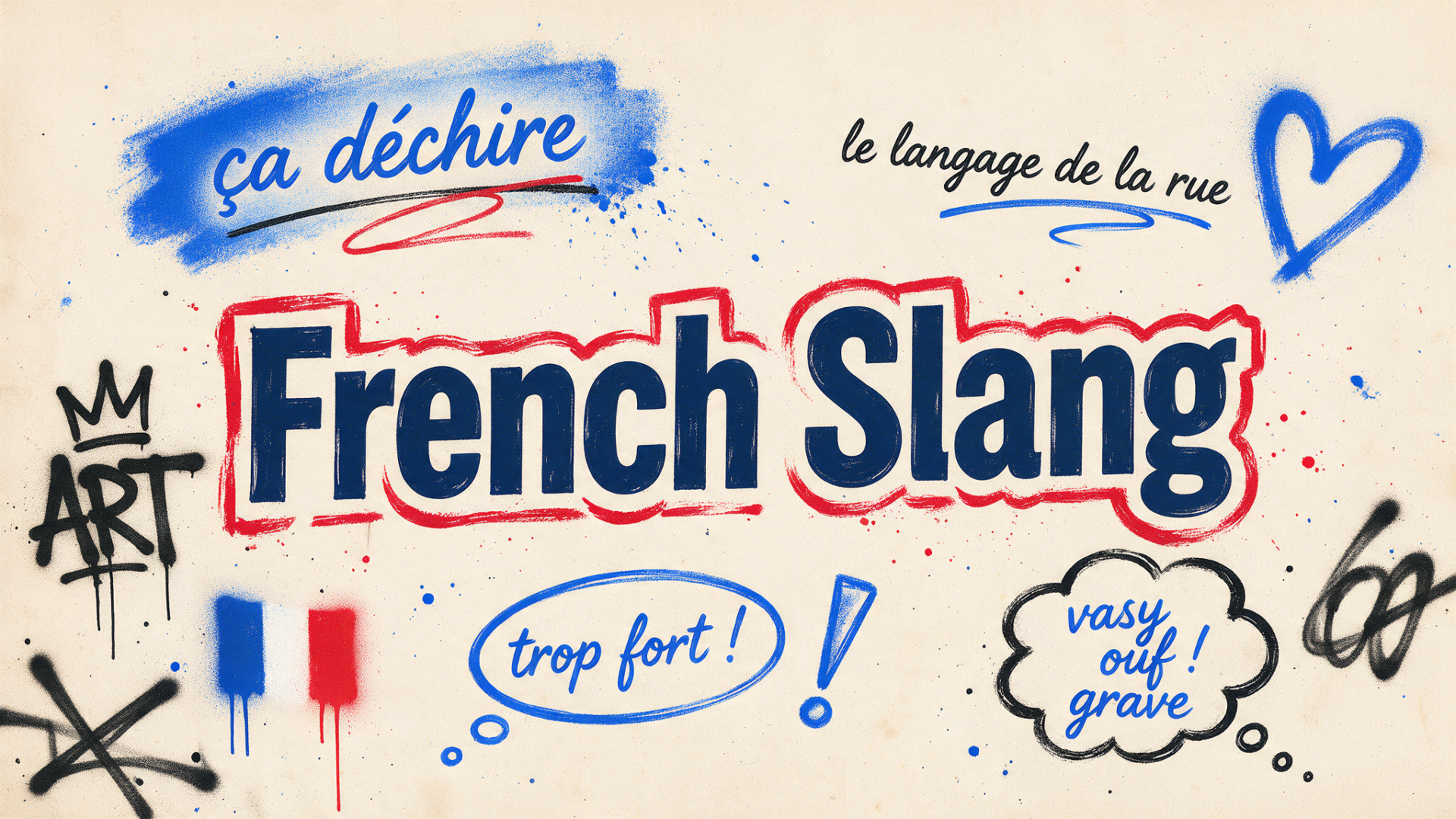
French slang is called l’argot. It includes informal words and expressions that are used mostly in speech, between friends, family members or people of the same age.
Slang is not the same as incorrect French. It is a different register, which means a different level of language. French speakers switch between registers all the time:
- Formal French: Je dois me rendre à mon travail. (I have to go to work.)
- Everyday French: Je dois aller au travail.
- Slang: Je dois aller au boulot.
Knowing slang will not just make you sound more natural. It will help you understand what people really say in conversations, movies and social media.
What are the most common French slang words?
Here are 35 slang words that you will hear often. Each example is in French first, with its English translation below.
French slang for people and family
| French slang | Meaning | Example |
|---|---|---|
| un mec | a guy, a dude | Ce mec est très sympa. This guy is really nice. |
| un pote | a friend, a buddy | Je sors avec mes potes ce soir. I’m going out with my friends tonight. |
| un gosse | a kid | Ses gosses font beaucoup de bruit. His kids are making a lot of noise. |
| un toubib | a doctor | Je dois aller chez le toubib demain. I have to go to the doctor tomorrow. |
| les darons | parents (a daron is a dad) | Mes darons habitent à Lyon. My parents live in Lyon. |
| un frangin / une frangine | a brother / a sister | J’ai un frangin et une frangine. I have a brother and a sister. |
French slang for everyday life
| French slang | Meaning | Example |
|---|---|---|
| le boulot | work, job | J’ai trop de boulot cette semaine. I have too much work this week. |
| bosser | to work | Il bosse dans une banque. He works in a bank. |
| le fric | money | Je n’ai plus de fric. I have no money left. |
| bouffer | to eat (and la bouffe = food) | On va bouffer au restaurant ce soir ? Shall we go eat at a restaurant tonight? |
| une bagnole | a car | Il a acheté une nouvelle bagnole. He bought a new car. |
| les fringues | clothes | J’adore tes fringues ! I love your clothes! |
| un bouquin | a book | Tu as lu ce bouquin ? Have you read this book? |
French slang to react and give your opinion
| French slang | Meaning | Example |
|---|---|---|
| kiffer | to love, to really like | Je kiffe cette chanson. I love this song. |
| nickel | perfect, spotless | Ton appart est nickel. Your flat is spotless. |
| grave | totally, really | Il est grave sympa. He’s really nice. |
| ça craint | that sucks | Ça craint, il pleut encore ! That sucks, it’s raining again! |
| une galère | a struggle, a hassle | Quelle galère, mon train est annulé ! What a hassle, my train is cancelled! |
| avoir la flemme | to be too lazy to do something | J’ai la flemme de cuisiner ce soir. I can’t be bothered to cook tonight. |
| c’est la honte | it’s embarrassing | J’ai oublié son prénom, c’est la honte ! I forgot his name, how embarrassing! |
What is verlan in French?
Verlan is a type of French slang where you reverse the syllables of a word. The word verlan itself is the reverse of l’envers (“the reverse”).
For example, femme (woman) becomes meuf, and fou (crazy) becomes ouf. Verlan is especially popular among young people, and many verlan words are now used by everyone.
| Verlan | Original word | Meaning / example |
|---|---|---|
| meuf | femme | a woman, a girl Cette meuf est drôle. This girl is funny. |
| ouf | fou | crazy C’est ouf, il a gagné ! That’s crazy, he won! |
| chelou | louche | weird, shady Ce type est chelou. This guy is weird. |
| relou | lourd | annoying Il est relou avec ses questions. He’s annoying with his questions. |
| zarbi | bizarre | strange Ce film est zarbi. This movie is strange. |
| teuf | fête | a party On va à une teuf samedi. We’re going to a party on Saturday. |
| keuf | flic | a cop Les keufs arrivent. The cops are coming. |
| cimer | merci | thanks Cimer pour ton aide ! Thanks for your help! |
What is French texting slang?
When French people text each other, they use many abbreviations. You will see these all the time on WhatsApp, Instagram and in comments.
| Abbreviation | Full form | Meaning / example |
|---|---|---|
| mdr | mort de rire | lol Mdr, trop drôle ! LOL, so funny! |
| jsp | je sais pas | I don’t know Jsp, demande-lui. I don’t know, ask him. |
| tkt | t’inquiète | don’t worry Tkt, je gère. Don’t worry, I’ve got it. |
| pk | pourquoi | why Pk tu ne réponds pas ? Why aren’t you answering? |
| dsl | désolé | sorry Dsl, je suis en retard. Sorry, I’m late. |
| bcp | beaucoup | a lot, thanks a lot Merci bcp ! Thanks a lot! |
| cc | coucou | hi, hey Cc, ça va ? Hey, how are you? |
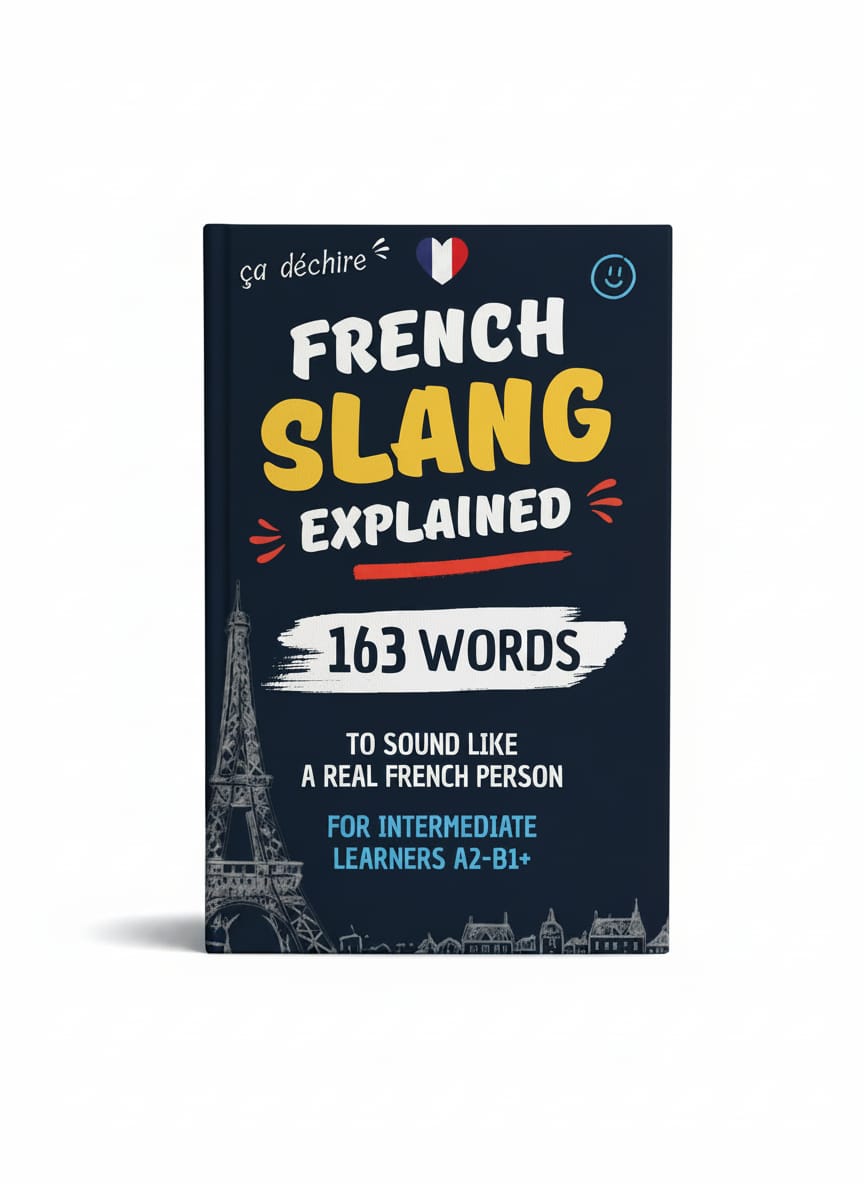
Want all 163 slang words?
Definitions, examples and short quizzes, organized by theme, in French Slang, Explained.
See the bookIs French slang rude?
Most French slang is simply informal, not rude. Words like boulot, pote or bagnole are perfectly fine with friends.
However, some slang words are vulgar or strong, such as merde, putain or con. They are very common in everyday speech, but they can offend people, so avoid using them with people you do not know well, at work or in writing.
When can you use French slang?
- With friends and family: yes, this is where slang is most natural.
- Online and in text messages: yes, abbreviations like mdr and tkt are everywhere.
- At work: it depends on your workplace. Start by listening to how your colleagues speak.
- In formal situations, emails or exams: avoid it. Use standard French instead.
A good rule: understand a lot of slang, but use it selectively. If you overuse it, you may sound unnatural, especially with people you have just met.
Slang also goes hand in hand with spoken grammar. For example, French speakers often say on instead of nous. If you want to learn how it works, read our guide on how to use “on” in French.
Practice exercise
Complete each sentence with the correct slang word from the box.
Word bank: fric · chelou · flemme · bouffer · dsl
a. Je n’ai plus de ______ pour acheter ce manteau.
b. Ce mec est vraiment ______, il me suit partout.
c. J’ai la ______ de sortir ce soir.
d. On va ______ au restaurant ce soir ?
e. Je suis en retard, ______ !
Answers
a. fric (I have no money left to buy this coat.)
b. chelou (This guy is really weird, he follows me everywhere.)
c. flemme (I can’t be bothered to go out tonight.)
d. bouffer (Shall we go eat at a restaurant tonight?)
e. dsl (I’m late, sorry!)
Key takeaways
- French slang is called l’argot. It is informal, not incorrect.
- Verlan reverses syllables: femme → meuf, fou → ouf.
- Texting slang (mdr, tkt, jsp) is used constantly online.
- Use slang with friends. Avoid it in formal situations.
- Some words, such as merde or putain, are vulgar: be careful with them.
Want to learn more French slang?
This article covers 35 words, but French slang is much richer. In my book French Slang, Explained, you will find 163 slang words organized by theme, with clear definitions, examples and short quizzes to help you remember them.
If you also want to practise everyday conversations, take a look at 100 French Dialogues, and learn the most useful verbs in our guide to the 20 most common French verbs.