
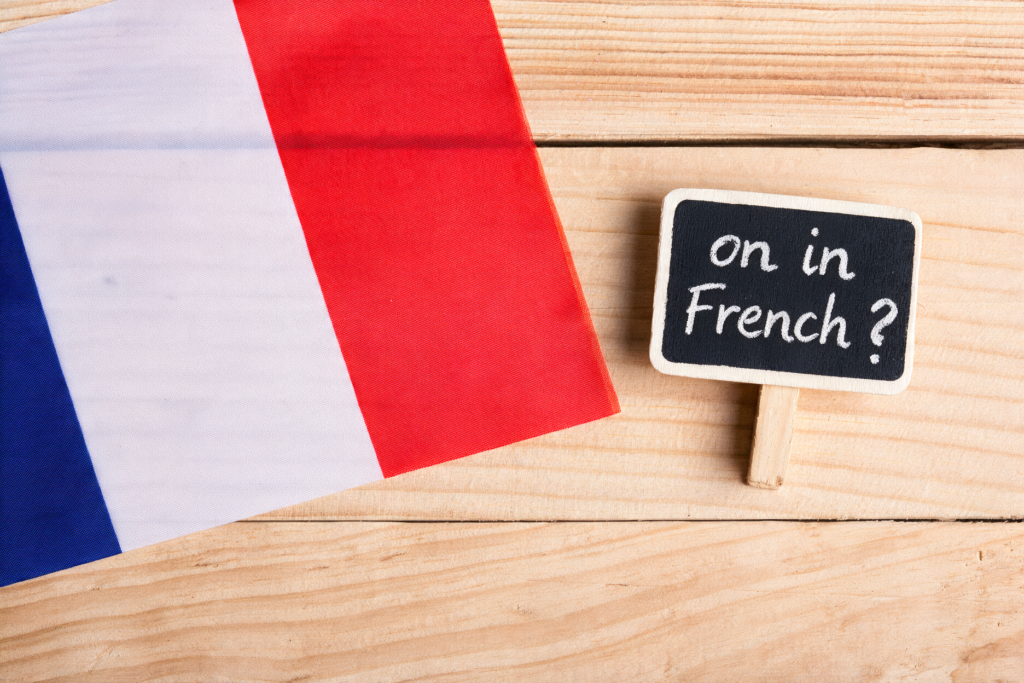
If you are learning French, you have probably noticed that the pronoun “on” appears everywhere. French speakers use it constantly in everyday conversation, but understanding exactly what it means can be confusing.
So, what does on mean in French? And when should you use it instead of nous?
In this guide, we’ll look at the different uses of on, with clear explanations and practical examples.
What does “on” mean in French?
The French pronoun on can have several different meanings depending on the context.
It can refer to:
- an unknown or unspecified person
- people in general
- an unspecified group of people
- a general situation
- “we” or “us” in everyday spoken French
One important rule to remember is that the verb following “on” is always conjugated in the third-person singular.
For example:
On parle français.
We speak French / People speak French.
Even when on means “we”, the verb is still conjugated like il or elle: on parle, not on parlons.
1. “On” for an unspecified person
One of the most common uses of on is to refer to a person whose identity is unknown, unspecified, or simply not important.
In English, you might translate this as “someone”, “they”, or sometimes “people”, depending on the context.
For example:
On m’a dit que tu étais malade.
Someone told me you were sick.
Here, we don’t know exactly who told the speaker that the person was sick. The identity of the person is not specified.
Another example:
On a volé mon vélo.
Someone stole my bike.
Again, on refers to an unidentified person or people.
2. “On” for general statements
On can also be used when talking about people in general or describing something that is generally true.
For example:
On doit éteindre les lumières en partant.
You have to turn off the lights when you leave.
Here, on doesn’t refer to one specific person. It means people in general.
Another very common example is:
Ici, on parle français.
French is spoken here.
People speak French here.
The exact English translation can change depending on the context, but the idea is the same: on refers to people in general rather than to a specific group.
3. “On” for an unspecified group of people
Sometimes on refers to a group of people without specifying exactly who they are.
For example:
On a besoin de plus de personnes pour aider à la collecte de fonds.
We need more people to help with the fundraising.
The group being referred to is not clearly identified. The speaker is simply talking about people who are involved in the situation.
4. “On” to describe a general situation
On can also be used to describe something that generally happens to people or that is true in a particular situation.
For example:
On s’ennuie facilement pendant les vacances.
It’s easy to get bored during the holidays.
Here, on doesn’t refer to a specific group. It expresses a general observation about what can happen during the holidays.
5. “On” means “we” in everyday French
This is probably the most important use of on for French learners.
In everyday spoken French, on is very often used instead of “nous” to mean “we”.
For example:
On va au cinéma ce soir.
We’re going to the cinema tonight.
On a vu ce film hier.
We saw this movie yesterday.
On peut commencer ?
Can we start?
Although nous is still perfectly correct, on is much more common in everyday conversation.
For example, a French speaker would naturally say:
On va manger ?
rather than:
Nous allons manger ?
The second sentence is grammatically correct, but it sounds more formal or deliberate in everyday conversation.
“On” and “nous”: what’s the difference?
When on means “we”, the verb is still conjugated in the third-person singular.
Compare:
- Nous sommes fatigués. → We are tired.
- On est fatigués. → We’re tired.
Notice that we say on est, not on sommes.
This is one of the easiest mistakes for English-speaking learners to make, so remember:
ON + third-person singular verb
For example:
- On est
- On va
- On fait
- On peut
- On a
- On doit
What about adjectives and past participles?
This is where things become a little more interesting.
When on means “we”, the adjective or past participle can agree with the people that on represents.
For example, if two women are talking about themselves, they can say:
On est contentes.
We’re happy.
If the group is made up of men or is mixed:
On est contents.
So although the verb remains singular, the adjective can reflect the gender and number of the people represented by on.
“On” can refer to “we” even when speaking to someone else
When on means “we”, it can refer to the speaker together with one or more other people.
For example:
Est-ce que vous voulez qu’on vous aide à porter les bagages ?
Would you like us to help you carry your luggage?
Here, on means “we” — the speaker and the people accompanying them.
Another example:
Est-ce qu’on peut vous offrir quelque chose à boire ?
Can we offer you something to drink?
“On” and the pronoun “nous”
There is another useful detail to remember.
When on means “we”, the corresponding stressed pronoun is still nous.
For example:
Vous, vous aimez les chats, et nous, on préfère les chiens.
You like cats, but we prefer dogs.
You wouldn’t normally say “on, on préfère les chiens”. When emphasizing the people represented by on, French uses nous.
Quick summary: the different meanings of “on”
| Use of “on” | Meaning | Example |
|---|---|---|
| Unspecified person | Someone / they | On m’a appelé. |
| General statement | People / you in general | On parle français ici. |
| Unspecified group | A group of people | On a besoin d’aide. |
| General situation | People generally / one | On s’ennuie facilement. |
| Personal “on” | We | On va au restaurant. |
Practice: Is “on” personal or impersonal?
Now it’s your turn. Decide whether on means “we” (personal) or refers to people in general / an unspecified person (impersonal).
- On parle beaucoup de ce sujet en ce moment.
- On peut aller au cinéma ce soir.
- On a vu le film hier soir.
- Il fait beau aujourd’hui, on devrait profiter du soleil.
- On dit que ce livre est très intéressant.
Answers
- Impersonal – People are talking a lot about this subject at the moment.
- Personal – We can go to the cinema tonight.
- Personal – We saw the movie last night.
- Personal – It’s nice outside; we should enjoy the sunshine.
- Impersonal – People say that this book is very interesting.
Final tip: listen for “on” everywhere!
If you want to sound more natural in French, getting comfortable with on is essential.
French speakers use on constantly in everyday conversations, especially when it means “we”. Once you start paying attention to it, you’ll hear it everywhere.
And remember the most important rule:
“On” always takes a third-person singular verb.
So:
- ✅ On est prêts.
- ❌
On sommes prêts.
Now that you understand the different uses of on, try listening for it in French conversations, movies, podcasts, and videos. You’ll quickly realize just how often French speakers use it!