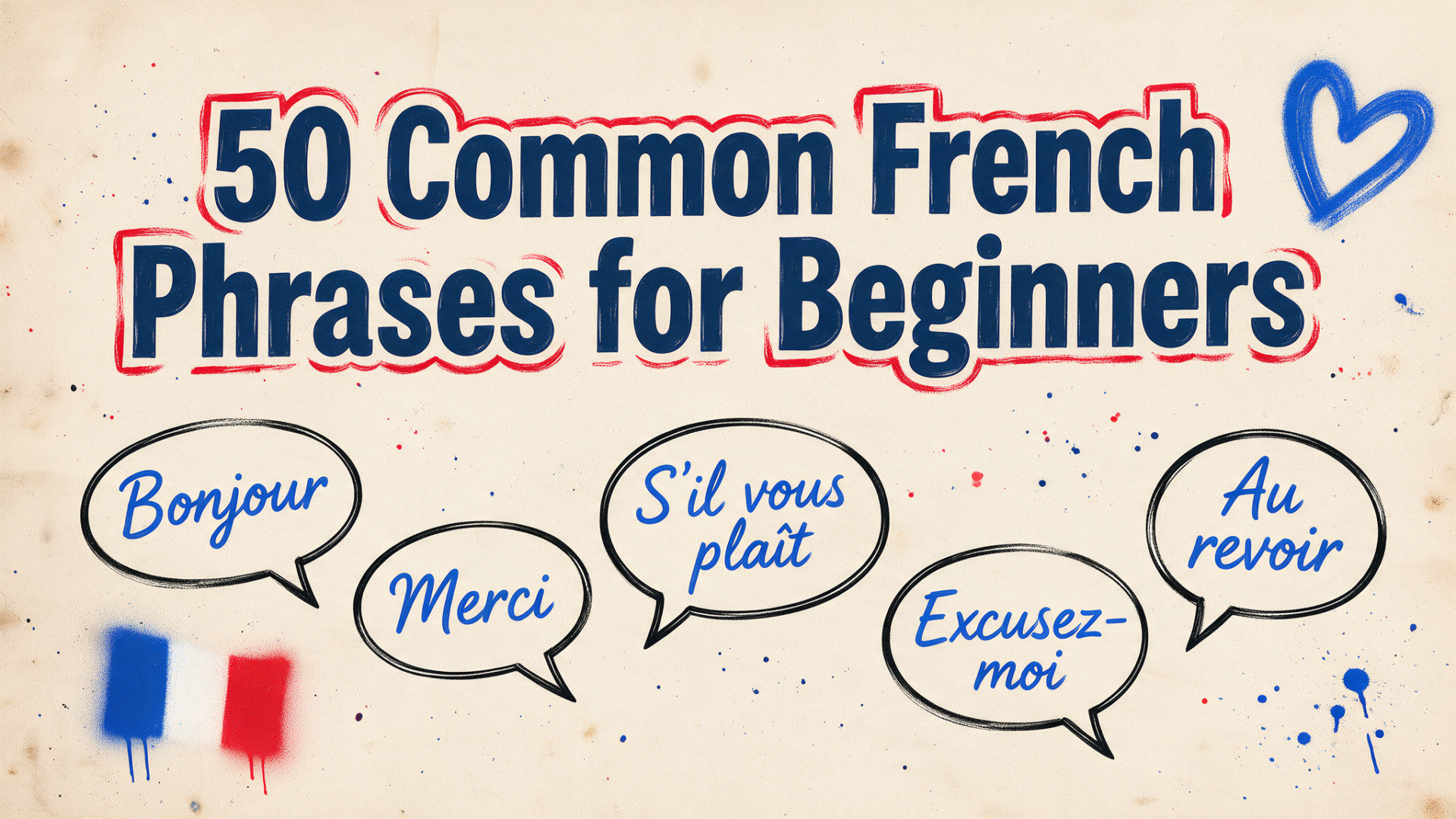
With just a few dozen phrases, you can greet people, order a coffee and ask for directions in French. Here are the 50 most common French phrases for beginners, grouped by situation, with their English translation.
What are the most common French phrases for beginners?
These are the phrases you will use the most, from greetings to emergencies.
Greetings and politeness
| French phrase | English |
|---|---|
| Bonjour | Hello / Good morning |
| Bonsoir | Good evening |
| Salut | Hi / Bye (informal) |
| Au revoir | Goodbye |
| À bientôt | See you soon |
| Merci | Thank you |
| Merci beaucoup | Thank you very much |
| S’il vous plaît | Please (formal) |
| De rien | You’re welcome |
| Excusez-moi | Excuse me |
Introducing yourself
| French phrase | English |
|---|---|
| Comment vous appelez-vous ? | What’s your name? (formal) |
| Je m’appelle… | My name is… |
| Enchanté(e) | Nice to meet you |
| Comment allez-vous ? | How are you? (formal) |
| Ça va ? | How’s it going? / I’m fine |
| Je viens de… | I come from… |
Asking for help and understanding
| French phrase | English |
|---|---|
| Parlez-vous anglais ? | Do you speak English? |
| Je ne comprends pas | I don’t understand |
| Pouvez-vous répéter, s’il vous plaît ? | Can you repeat, please? |
| Parlez plus lentement, s’il vous plaît | Please speak more slowly |
| Je ne sais pas | I don’t know |
| Comment dit-on… en français ? | How do you say… in French? |
| Désolé(e) | I’m sorry |
At the restaurant or café
| French phrase | English |
|---|---|
| Une table pour deux, s’il vous plaît | A table for two, please |
| Je voudrais… | I would like… |
| Un café, s’il vous plaît | A coffee, please |
| Une carafe d’eau, s’il vous plaît | A jug of tap water, please |
| Qu’est-ce que vous recommandez ? | What do you recommend? |
| C’était délicieux ! | It was delicious! |
| L’addition, s’il vous plaît | The bill, please |
Shopping and money
| French phrase | English |
|---|---|
| Combien ça coûte ? | How much is it? |
| C’est trop cher | It’s too expensive |
| Je regarde seulement, merci | I’m just looking, thanks |
| Je prends ça | I’ll take this |
| Je peux payer par carte ? | Can I pay by card? |
Getting around and travelling
| French phrase | English |
|---|---|
| Où sont les toilettes ? | Where are the toilets? |
| Où est la gare ? | Where is the train station? |
| À gauche / à droite | Left / right |
| Tout droit | Straight ahead |
| C’est loin ? | Is it far? |
| Un billet pour Paris, s’il vous plaît | A ticket to Paris, please |
| À quelle heure part le train ? | What time does the train leave? |
Feelings, opinions and emergencies
| French phrase | English |
|---|---|
| J’ai faim | I’m hungry |
| J’ai soif | I’m thirsty |
| Je suis fatigué(e) | I’m tired |
| Je suis d’accord | I agree |
| Pas de problème | No problem |
| Ça m’est égal | I don’t mind |
| Au secours ! | Help! |
| J’ai besoin d’un médecin | I need a doctor |
Want to hear these phrases in real conversations?
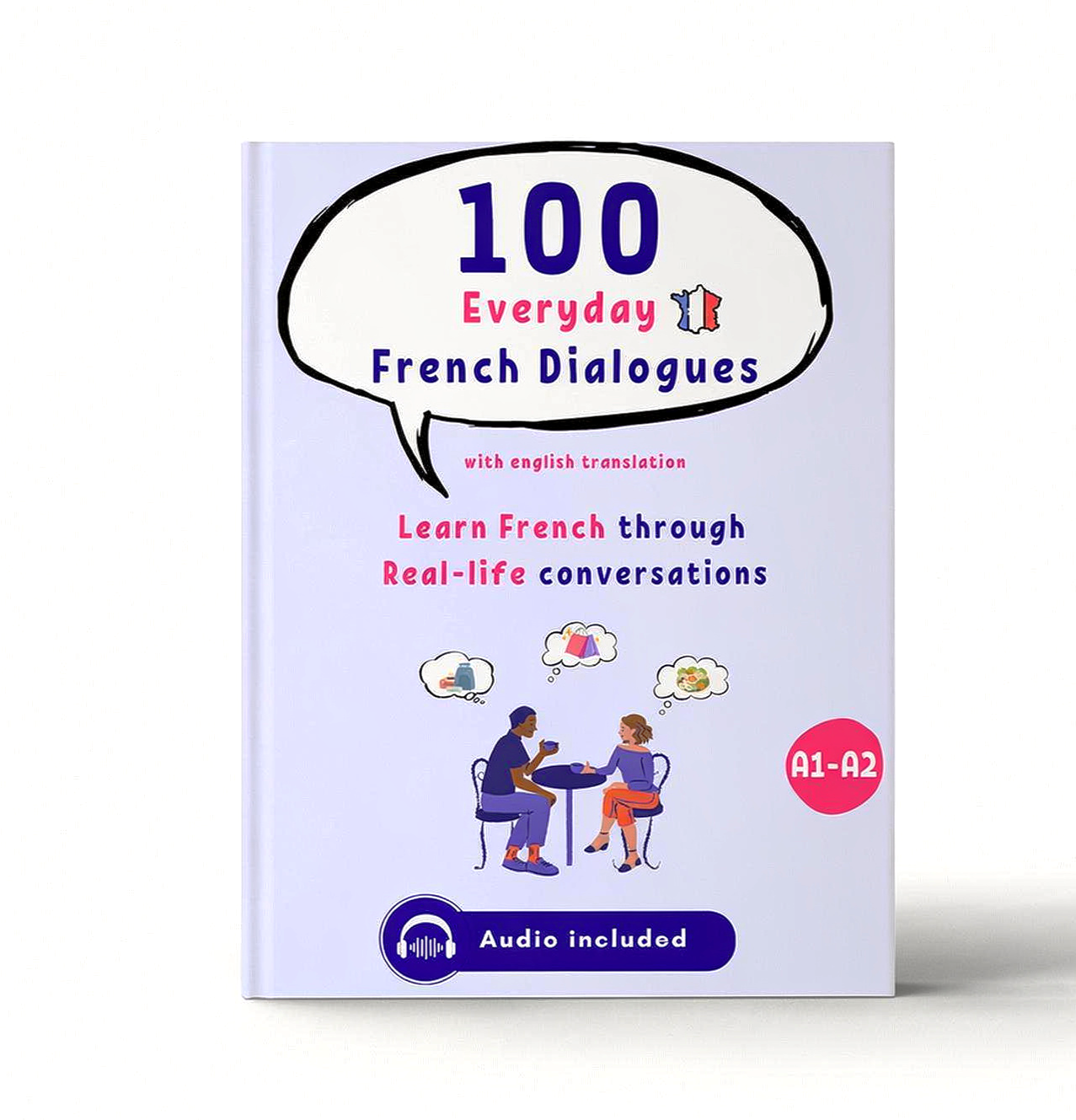
100 French Dialogues gives you 100 everyday conversations with audio, so you can practise listening and pronunciation.
See the bookShould you use “tu” or “vous” with these phrases?
In French, there are two ways to say “you”: tu (informal) and vous (formal or plural). Most phrases in this guide use the polite form, which is the safest choice with strangers, shop staff, waiters and anyone older than you.
Use tu with friends, family and young people. If you are unsure, use vous: nobody will be offended. For example, Comment allez-vous ? (formal) becomes Comment vas-tu ? or simply Ça va ? (informal).
Why should you always say “bonjour” first?
In France, greeting people is not optional. When you enter a shop, a café, a bakery or an office, say bonjour before anything else, even if you only want to ask a quick question.
Starting with a simple Bonjour, excusez-moi… makes people much more willing to help you. Jumping straight to Où est la gare ? can sound rude, even if you did not mean it that way.
How do you pronounce French phrases?
- The stress is on the last syllable: in bonjour, you stress “jour”, not “bon”.
- Final consonants are often silent: in petit or beaucoup, you do not pronounce the last letter.
- Words link together: the “s” of vous is pronounced in vous allez, as if it were “vou-zallez”. This is called a liaison.
- The French “r” comes from the throat, not from the tip of the tongue. Practise with merci and au revoir.
The best way to improve is to listen to native speakers and repeat out loud.
How can you learn these French phrases quickly?
- Learn 5 phrases at a time, not 50. Pick one situation (for example, the café) and practise it for a few days.
- Say them out loud. Your mouth needs practice as much as your memory does.
- Use them in real life: greet someone in French, order your coffee in French, or talk to yourself while cooking.
- Listen to audio. Hearing the rhythm of the sentence helps much more than reading it.
- Review the next day. Short, repeated sessions work better than one long session.
Practice exercise
What would you say in each situation? Choose the best French phrase.
1. You enter a bakery in the morning.
2. You did not understand what the waiter said.
3. You want to ask for the bill.
4. You want to know the price of a jacket.
5. You are lost and need the toilets.
Word bank: Combien ça coûte ? · Bonjour · L’addition, s’il vous plaît · Où sont les toilettes ? · Pouvez-vous répéter, s’il vous plaît ?
Answers
1. Bonjour (Hello)
2. Pouvez-vous répéter, s’il vous plaît ? (Can you repeat, please?)
3. L’addition, s’il vous plaît (The bill, please)
4. Combien ça coûte ? (How much is it?)
5. Où sont les toilettes ? (Where are the toilets?)
Key takeaways
- Start with a few phrases per situation instead of trying to learn everything.
- Always say bonjour when you enter a place, and add s’il vous plaît and merci.
- Use vous with strangers, tu with friends.
- Stress the last syllable and listen to native audio to improve your pronunciation.
- Practise out loud, a little every day.
Ready to go beyond basic phrases?
Once you know these essentials, the next step is to understand how French people really talk. Discover the informal words they use every day in our guide to French slang, or learn how to use the pronoun “on” in French.
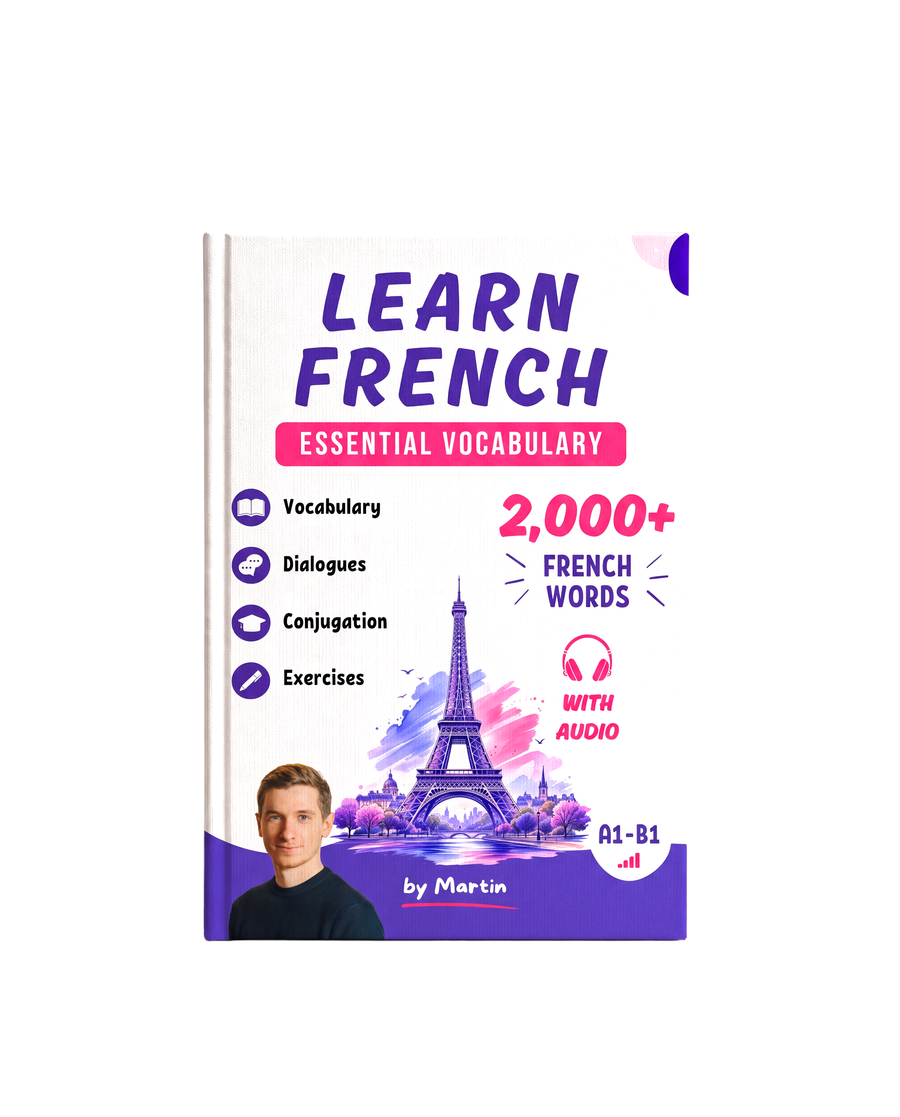
To practise full conversations with audio, my book 100 French Dialogues is made for A1-A2 learners. And if you want to build your vocabulary, Essential French Vocabulary gives you over 2,000 words with dialogues and exercises.